
Tools / Limbus
Netra Limbus
GitHubVision AI for anyone: an infinite-canvas desktop app for running state-of-the-art vision models locally, with no cloud and no frames leaving your hardware. Annotate image segmentation data fast, on your own machine.
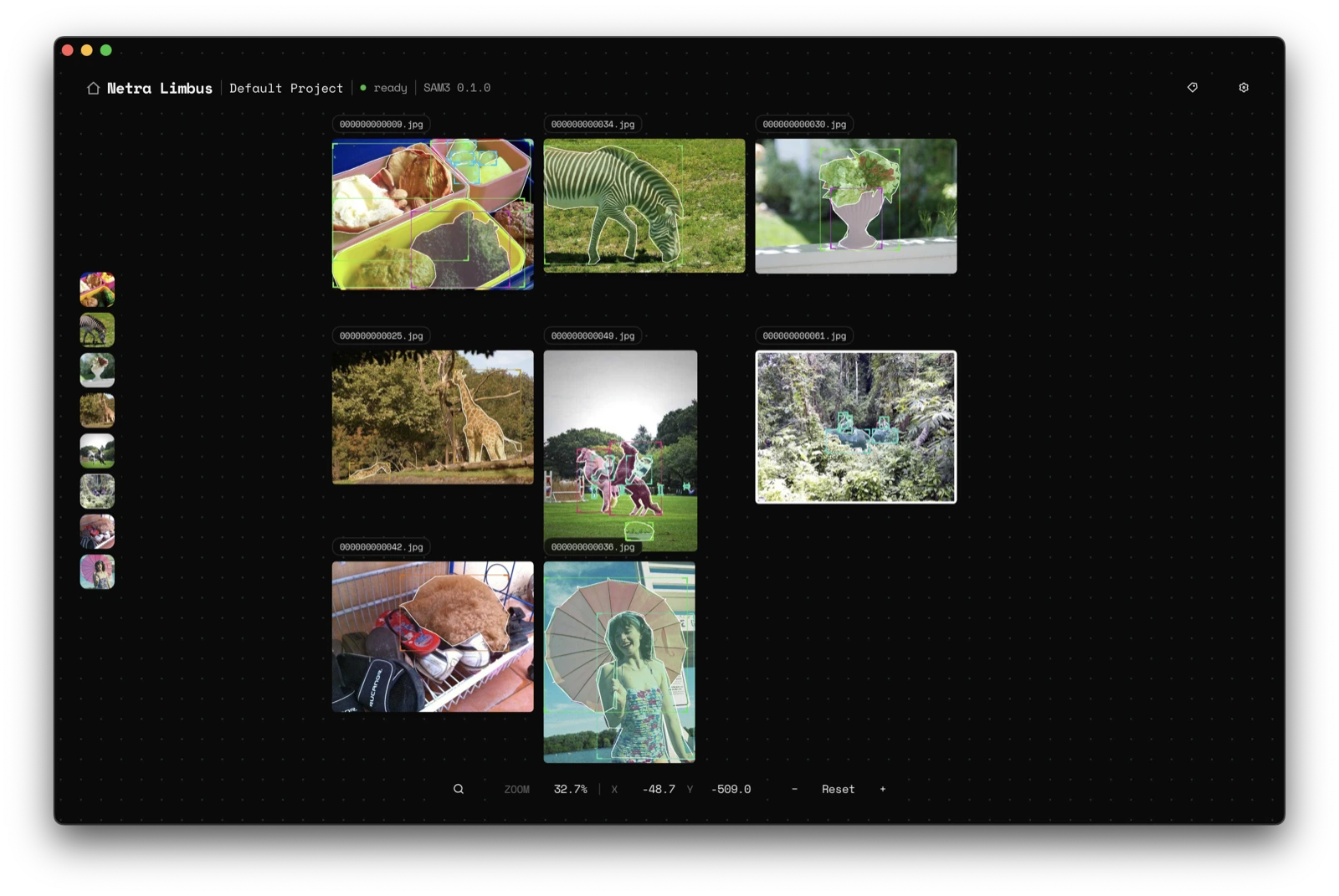
What it does
Drop images onto an infinite canvas and segment them with SAM3 (click a point, drag a box, or type what you want, like "zebra"), then label the masks. It's local-first: your images and annotations never leave your machine, and segmentation runs on-device (Metal/Accelerate on macOS), so it's fast with no per-image cloud cost.
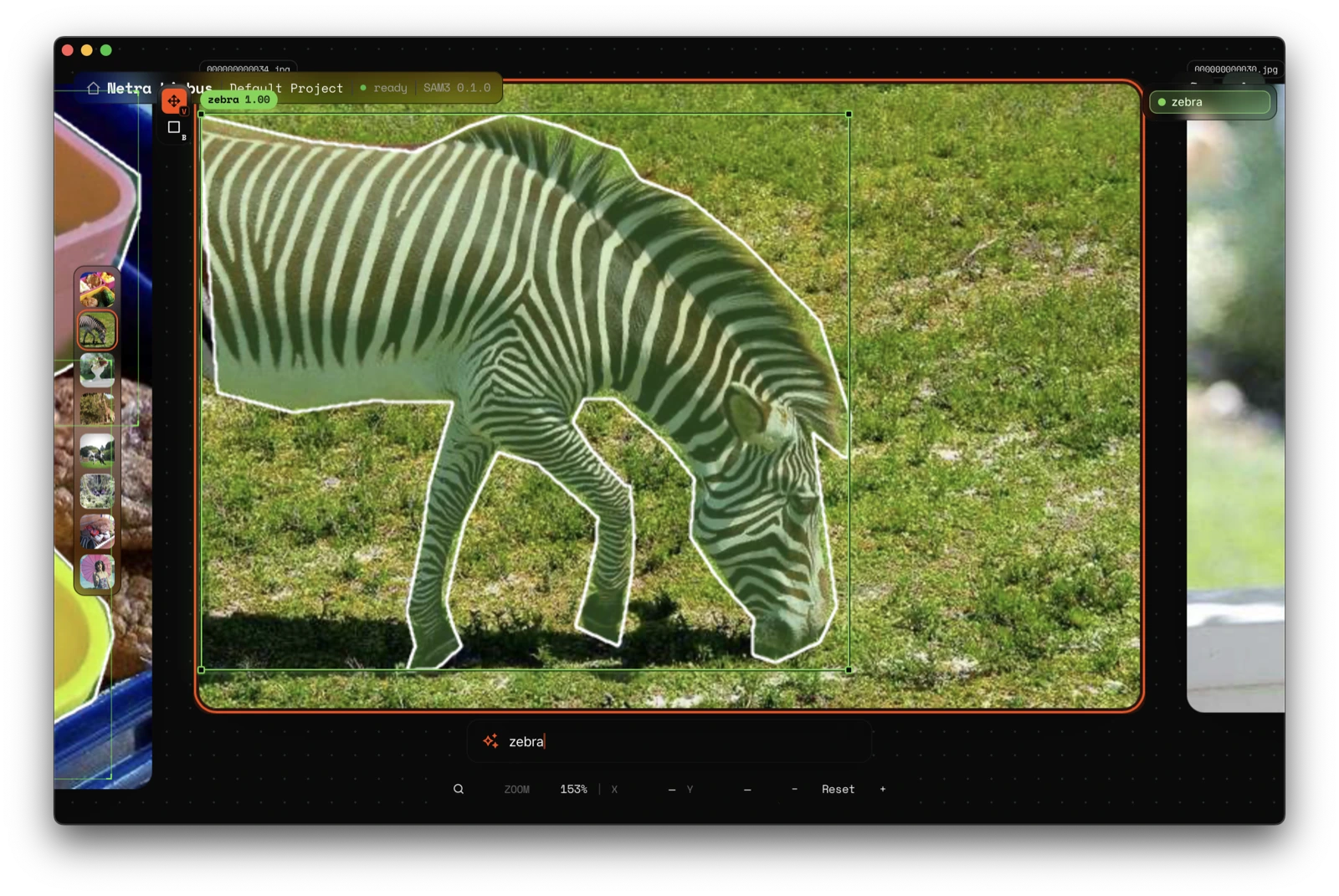
Highlights
- SAM3-powered segmentation via point, box, or text prompts.
- Local-first: images and annotations stay on-device.
- Hardware-accelerated with Metal/Accelerate on macOS.
- Infinite canvas with multi-project support, undo/redo, and level-of-detail rendering.
- Imports images, folders, zips, and existing annotations (e.g. COCO).
- Built on sam3.c, a pure-C port of Segment Anything 3, by the Netra Runtime team.
How it works
Limbus is a desktop app built around an infinite canvas. You drop images (single files, whole folders, or zips) onto the canvas and pan and zoom freely; level-of-detail rendering keeps it smooth even with large images and many annotations. To label an object you prompt SAM3 directly on the image: click a point on it, drag a box around it, or type what it is ("zebra", "left headlight"), and the model returns a mask you can accept, refine, and tag. Because segmentation is the slow part of dataset work, doing it interactively with a model turns minutes of manual polygon-drawing into a click.
Everything runs on your machine. The segmentation model executes on-device through sam3.c, using Metal and Accelerate on macOS, so no image is ever uploaded and there is no per-image cloud cost. Images and annotations are stored locally in an embedded database, and the app can import and export common formats like COCO, so a dataset you build in Limbus drops straight into an existing training pipeline. Multi-project support and undo/redo make it practical for real annotation sessions rather than one-off demos.
Why local-first matters
Segmentation datasets are often built from sensitive imagery: medical scans, proprietary products, private photos. Sending those frames to a cloud service is a privacy and cost problem. Limbus keeps the model and the data on your hardware, which means the frames never leave the machine, the work continues offline, and there is no metered API bill that scales with the size of your dataset. It is the same on-device philosophy as sam3.c, wrapped in a tool a human can actually annotate with.
Learn more
New to segmentation? Read what image segmentation is and how Segment Anything works.